 Add to Chrome
 Add to Firefox
 Add to Edge
A Heterogeneous Architecture for Robot RL Beyond GPU-Dominant Paradigms
May 28, 2026
Simulation-based RL for contemporary robot control is increasingly organized around GPU-resident simulation: physics, rollout collection, and learning are placed on a single GPU-centric execution path. This paradigm has greatly improved training speed, but it has also encouraged a default assumption that efficient training requires physics to reside on the GPU. We revisit this assumption. Our view is that, in simulation-dominated robot control, the essential question is not which processor runs physics, but whether simulation throughput, policy learning, and runtime synchronization form an efficient end-to-end loop. We present UniLab, a heterogeneous CPU-simulation / GPU-learning architecture that decouples CPU-parallel simulation from GPU policy updates through a unified runtime for data movement, buffering, and synchronization. UniLab is implemented as a complete and extensible training system using MuJoCoUni and MotrixSim CPU-batched physics backends, supporting PPO, SAC, FlashSAC, TD3, and APPO. On representative simulation-based robot control tasks, UniLab improves end-to-end training efficiency by 3--10$\times$ under the same hardware configuration, while reducing dependence on the NVIDIA CUDA-based software stack and supporting cross-platform execution on the Apple macOS platform and the AMD ROCm and Intel XPU accelerator backends. These results show that GPU simulation is an effective path to efficient training, but not a necessary one, broadening the practical system choices available for robot RL training. Project page: https://github.com/unilabsim/UniLab.

More Edits, More Stable: Understanding the Lifelong Normalization in Sequential Model Editing
May 12, 2026Lifelong Model Editing aims to continuously update evolving facts in Large Language Models while preserving unrelated knowledge and general capabilities, yet it remains plagued by catastrophic forgetting and model collapse. Empirically, we find that recent editors resilient over long horizons share the same core strategy: Lifelong Normalization (LN), which normalizes value gradients using running statistics. Removing LN causes immediate performance collapse, and we observe a counter-intuitive positive cumulative effect where early edits can promote the success of future edits. Yet the mechanism of LN remains a "black box", leaving its precise role in lifelong stability poorly understood. In this work, we provide the first theoretical account of LN in the lifelong regime. Our analysis reveals a self-reinforcing stability loop and proves that, when combined with ridge-regularized regression, LN yields parameter updates with asymptotic orthogonality and bounded norms, directly mitigating forgetting and systemic collapse. Based on these insights, we derive StableEdit, which strengthens this stability loop via an explicit warm-up stage and full whitening, improving long-horizon stability at minimal overhead. Extensive experiments validate our theory and demonstrate competitive performance. Our code is available at https://github.com/MINE-USTC/StableEdit.
Fine-Grained Action Segmentation for Renorrhaphy in Robot-Assisted Partial Nephrectomy
Apr 10, 2026Fine-grained action segmentation during renorrhaphy in robot-assisted partial nephrectomy requires frame-level recognition of visually similar suturing gestures with variable duration and substantial class imbalance. The SIA-RAPN benchmark defines this problem on 50 clinical videos acquired with the da Vinci Xi system and annotated with 12 frame-level labels. The benchmark compares four temporal models built on I3D features: MS-TCN++, AsFormer, TUT, and DiffAct. Evaluation uses balanced accuracy, edit score, segmental F1 at overlap thresholds of 10, 25, and 50, frame-wise accuracy, and frame-wise mean average precision. In addition to the primary evaluation across five released split configurations on SIA-RAPN, the benchmark reports cross-domain results on a separate single-port RAPN dataset. Across the strongest reported values over those five runs on the primary dataset, DiffAct achieves the highest F1, frame-wise accuracy, edit score, and frame mAP, while MS-TCN++ attains the highest balanced accuracy.
Evaluating an evidence-guided reinforcement learning framework in aligning light-parameter large language models with decision-making cognition in psychiatric clinical reasoning
Feb 06, 2026Large language models (LLMs) hold transformative potential for medical decision support yet their application in psychiatry remains constrained by hallucinations and superficial reasoning. This limitation is particularly acute in light-parameter LLMs which are essential for privacy-preserving and efficient clinical deployment. Existing training paradigms prioritize linguistic fluency over structured clinical logic and result in a fundamental misalignment with professional diagnostic cognition. Here we introduce ClinMPO, a reinforcement learning framework designed to align the internal reasoning of LLMs with professional psychiatric practice. The framework employs a specialized reward model trained independently on a dataset derived from 4,474 psychiatry journal articles and structured according to evidence-based medicine principles. We evaluated ClinMPO on a unseen subset of the benchmark designed to isolate reasoning capabilities from rote memorization. This test set comprises items where leading large-parameter LLMs consistently fail. We compared the ClinMPO-aligned light LLM performance against a cohort of 300 medical students. The ClinMPO-tuned Qwen3-8B model achieved a diagnostic accuracy of 31.4% and surpassed the human benchmark of 30.8% on these complex cases. These results demonstrate that medical evidence-guided optimization enables light-parameter LLMs to master complex reasoning tasks. Our findings suggest that explicit cognitive alignment offers a scalable pathway to reliable and safe psychiatric decision support.
A Unified Complementarity-based Approach for Rigid-Body Manipulation and Motion Prediction
Feb 04, 2026Robotic manipulation in unstructured environments requires planners to reason jointly about free-space motion and sustained, frictional contact with the environment. Existing (local) planning and simulation frameworks typically separate these regimes or rely on simplified contact representations, particularly when modeling non-convex or distributed contact patches. Such approximations limit the fidelity of contact-mode transitions and hinder the robust execution of contact-rich behaviors in real time. This paper presents a unified discrete-time modeling framework for robotic manipulation that consistently captures both free motion and frictional contact within a single mathematical formalism (Unicomp). Building on complementarity-based rigid-body dynamics, we formulate free-space motion and contact interactions as coupled linear and nonlinear complementarity problems, enabling principled transitions between contact modes without enforcing fixed-contact assumptions. For planar patch contact, we derive a frictional contact model from the maximum power dissipation principle in which the set of admissible contact wrenches is represented by an ellipsoidal limit surface. This representation captures coupled force-moment effects, including torsional friction, while remaining agnostic to the underlying pressure distribution across the contact patch. The resulting formulation yields a discrete-time predictive model that relates generalized velocities and contact wrenches through quadratic constraints and is suitable for real-time optimization-based planning. Experimental results show that the proposed approach enables stable, physically consistent behavior at interactive speeds across tasks, from planar pushing to contact-rich whole-body maneuvers.
Dynamic Facial Expressions Analysis Based Parkinson's Disease Auxiliary Diagnosis
Dec 10, 2025Parkinson's disease (PD), a prevalent neurodegenerative disorder, significantly affects patients' daily functioning and social interactions. To facilitate a more efficient and accessible diagnostic approach for PD, we propose a dynamic facial expression analysis-based PD auxiliary diagnosis method. This method targets hypomimia, a characteristic clinical symptom of PD, by analyzing two manifestations: reduced facial expressivity and facial rigidity, thereby facilitating the diagnosis process. We develop a multimodal facial expression analysis network to extract expression intensity features during patients' performance of various facial expressions. This network leverages the CLIP architecture to integrate visual and textual features while preserving the temporal dynamics of facial expressions. Subsequently, the expression intensity features are processed and input into an LSTM-based classification network for PD diagnosis. Our method achieves an accuracy of 93.1%, outperforming other in-vitro PD diagnostic approaches. This technique offers a more convenient detection method for potential PD patients, improving their diagnostic experience.
Everything-Grasping (EG) Gripper: A Universal Gripper with Synergistic Suction-Grasping Capabilities for Cross-Scale and Cross-State Manipulation
Oct 06, 2025Grasping objects across vastly different sizes and physical states-including both solids and liquids-with a single robotic gripper remains a fundamental challenge in soft robotics. We present the Everything-Grasping (EG) Gripper, a soft end-effector that synergistically integrates distributed surface suction with internal granular jamming, enabling cross-scale and cross-state manipulation without requiring airtight sealing at the contact interface with target objects. The EG Gripper can handle objects with surface areas ranging from sub-millimeter scale 0.2 mm2 (glass bead) to over 62,000 mm2 (A4 sized paper and woven bag), enabling manipulation of objects nearly 3,500X smaller and 88X larger than its own contact area (approximated at 707 mm2 for a 30 mm-diameter base). We further introduce a tactile sensing framework that combines liquid detection and pressure-based suction feedback, enabling real-time differentiation between solid and liquid targets. Guided by the actile-Inferred Grasping Mode Selection (TIGMS) algorithm, the gripper autonomously selects grasping modes based on distributed pressure and voltage signals. Experiments across diverse tasks-including underwater grasping, fragile object handling, and liquid capture-demonstrate robust and repeatable performance. To our knowledge, this is the first soft gripper to reliably grasp both solid and liquid objects across scales using a unified compliant architecture.
Consistent and Controllable Image Animation with Motion Linear Diffusion Transformers
Aug 10, 2025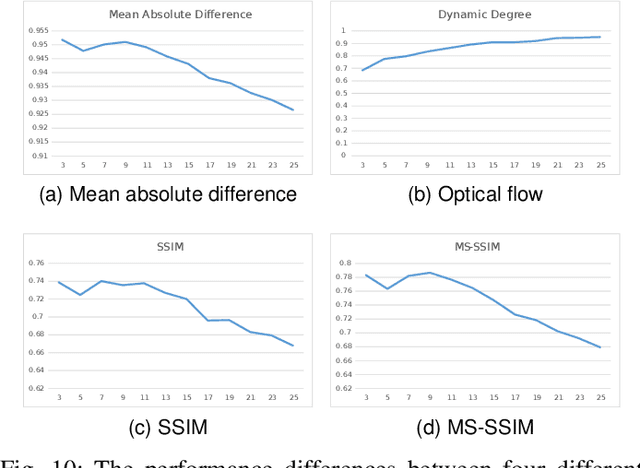

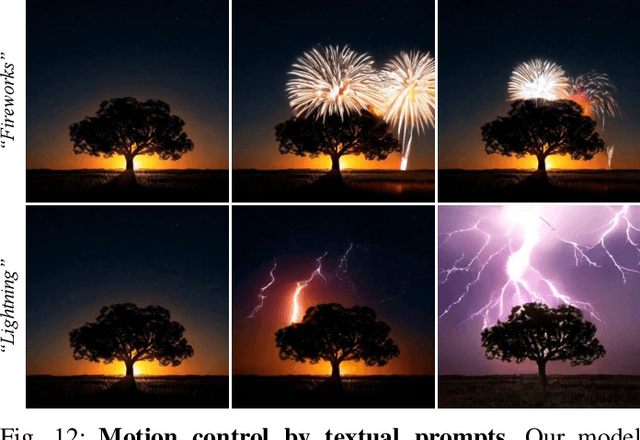
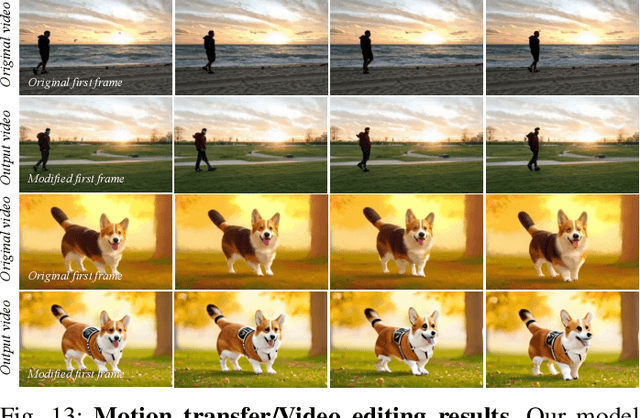
Image animation has seen significant progress, driven by the powerful generative capabilities of diffusion models. However, maintaining appearance consistency with static input images and mitigating abrupt motion transitions in generated animations remain persistent challenges. While text-to-video (T2V) generation has demonstrated impressive performance with diffusion transformer models, the image animation field still largely relies on U-Net-based diffusion models, which lag behind the latest T2V approaches. Moreover, the quadratic complexity of vanilla self-attention mechanisms in Transformers imposes heavy computational demands, making image animation particularly resource-intensive. To address these issues, we propose MiraMo, a framework designed to enhance efficiency, appearance consistency, and motion smoothness in image animation. Specifically, MiraMo introduces three key elements: (1) A foundational text-to-video architecture replacing vanilla self-attention with efficient linear attention to reduce computational overhead while preserving generation quality; (2) A novel motion residual learning paradigm that focuses on modeling motion dynamics rather than directly predicting frames, improving temporal consistency; and (3) A DCT-based noise refinement strategy during inference to suppress sudden motion artifacts, complemented by a dynamics control module to balance motion smoothness and expressiveness. Extensive experiments against state-of-the-art methods validate the superiority of MiraMo in generating consistent, smooth, and controllable animations with accelerated inference speed. Additionally, we demonstrate the versatility of MiraMo through applications in motion transfer and video editing tasks.
Training-free Stylized Text-to-Image Generation with Fast Inference
May 25, 2025Although diffusion models exhibit impressive generative capabilities, existing methods for stylized image generation based on these models often require textual inversion or fine-tuning with style images, which is time-consuming and limits the practical applicability of large-scale diffusion models. To address these challenges, we propose a novel stylized image generation method leveraging a pre-trained large-scale diffusion model without requiring fine-tuning or any additional optimization, termed as OmniPainter. Specifically, we exploit the self-consistency property of latent consistency models to extract the representative style statistics from reference style images to guide the stylization process. Additionally, we then introduce the norm mixture of self-attention, which enables the model to query the most relevant style patterns from these statistics for the intermediate output content features. This mechanism also ensures that the stylized results align closely with the distribution of the reference style images. Our qualitative and quantitative experimental results demonstrate that the proposed method outperforms state-of-the-art approaches.
Fish Mouth Inspired Origami Gripper for Robust Multi-Type Underwater Grasping
Mar 14, 2025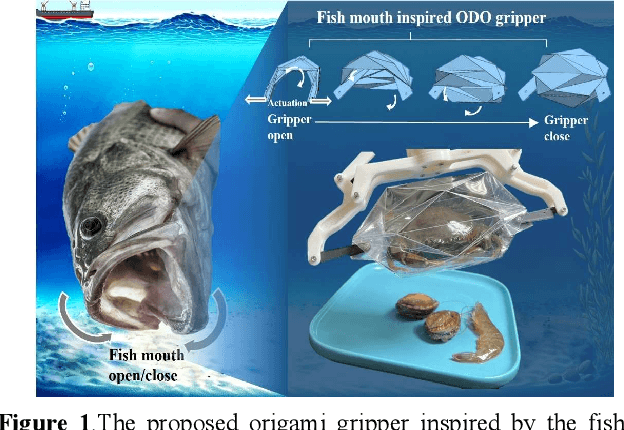

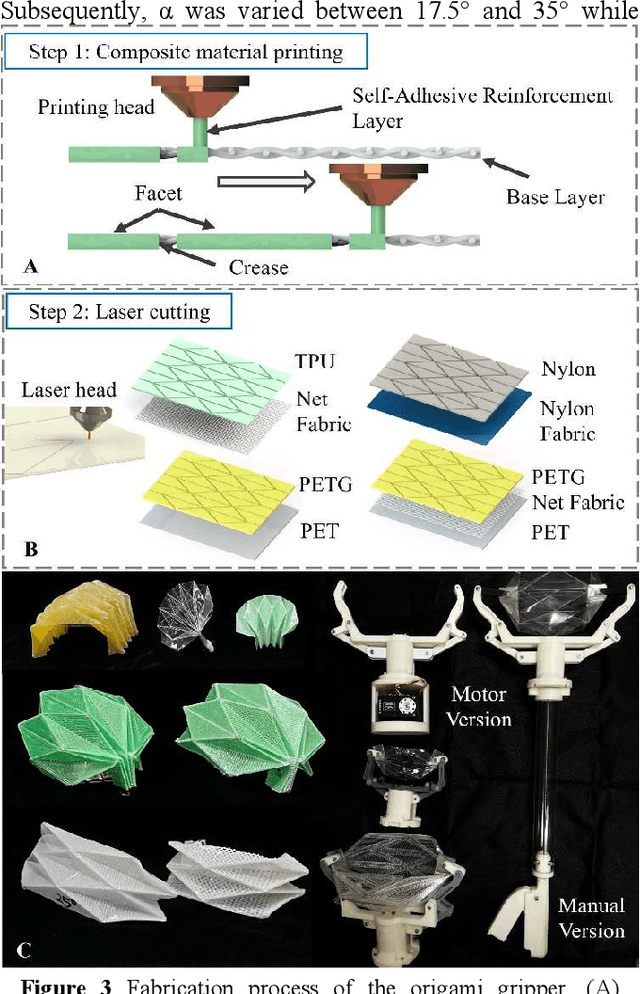
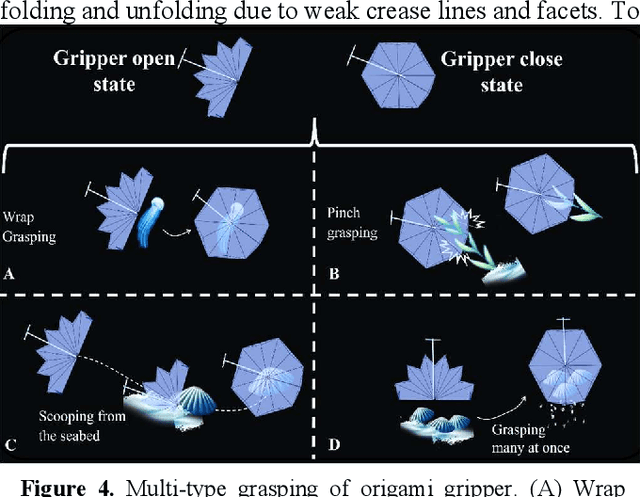
Robotic grasping and manipulation in underwater environments present unique challenges for robotic hands traditionally used on land. These challenges stem from dynamic water conditions, a wide range of object properties from soft to stiff, irregular object shapes, and varying surface frictions. One common approach involves developing finger-based hands with embedded compliance using underactuation and soft actuators. This study introduces an effective alternative solution that does not rely on finger-based hand designs. We present a fish mouth inspired origami gripper that utilizes a single degree of freedom to perform a variety of robust grasping tasks underwater. The innovative structure transforms a simple uniaxial pulling motion into a grasping action based on the Yoshimura crease pattern folding. The origami gripper offers distinct advantages, including scalable and optimizable design, grasping compliance, and robustness, with four grasping types: pinch, power grasp, simultaneous grasping of multiple objects, and scooping from the seabed. In this work, we detail the design, modeling, fabrication, and validation of a specialized underwater gripper capable of handling various marine creatures, including jellyfish, crabs, and abalone. By leveraging an origami and bio-inspired approach, the presented gripper demonstrates promising potential for robotic grasping and manipulation in underwater environments.